
AI Litigation Briefing — September 29, 2026

Executive Summary
The September 29 briefing opens with two articles I recently published on Law.com: “7 AI Checks Before Serving a New York Expert Report,” published by the New York Law Journal on September 28, and “When AI Agents Act, Where Should the Human Check Go?,” published by Legaltech News on September 24. The remaining verified developments cover cross-border litigation, evidence, law-firm data security, court access, judicial AI governance, Canadian legal workflows, and patent practice. Across all ten items, I keep coming back to one practical question: if the work is challenged later, can the legal team reconstruct the source, the system action, the sensitive-data path, the exception, and the human decision that mattered?
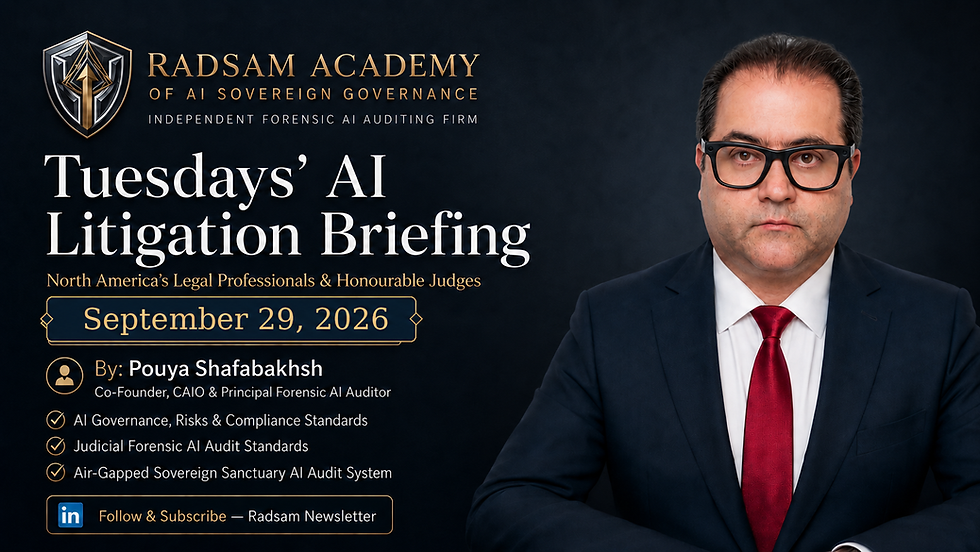
This is an honest AI disclosure. This briefing presents my analysis, as Pouya Shafabakhsh, from the perspective of AI governance, risk, compliance, and AI litigation. For the convenience of legal professionals and busy executives, this page also includes a podcast. The written briefing on this page is the controlling substantive analysis; a verbatim transcript is not currently available.
I. 7 AI Checks Before Serving a New York Expert Report
Case or Development Summary and Status
I recently published “7 AI Checks Before Serving a New York Expert Report” in the New York Law Journal on September 28, 2026. The article is professional commentary, not a court ruling or binding requirement. Its practical focus is the point immediately before an expert report leaves the litigation team, when AI-assisted research, drafting, calculations, quotation handling, document review, or editing may have affected the record. The governance issue is not whether AI was used in the abstract, but whether the report’s material propositions can be traced, checked, and approved before service. That makes pre-service verification a litigation-control function formally.
Litigation AI GRC Analysis
For Litigation AI GRC, the useful control is a defined release gate for expert work rather than a generic instruction to “check the AI.” A defensible workflow should identify the source set and report version under review, separate expert judgment from machine-assisted extraction or drafting, expose unresolved exceptions, and record who completed review. Where calculations, quotations, citations, images, exhibits, or factual assumptions matter, the process should make the supporting record available to the responsible professional. The objective is not to treat every technical tool as legally significant; it is to prevent silent automation errors from surviving into served expert material.
Strategic Risk Management Recommendation
Managing partners should operationalize this as a matter-level checklist with named ownership and evidence of completion. The release package can preserve the final report, authoritative sources relied upon, material input files, exception notes, approval record, and any AI-related workflow logs that the firm has determined should be retained. This is a governance recommendation, not a conclusion about discoverability, privilege, admissibility, or disclosure, which remain matter-specific legal questions. The strategic benefit is reconstruction: if a quotation, calculation, source, or expert conclusion is later challenged, the team can explain what was checked, by whom, against which record, before the report was served.
II. When AI Agents Act, Where Should the Human Check Go?
Case or Development Summary and Status
I recently published “When AI Agents Act, Where Should the Human Check Go?” in Law.com Legaltech News on September 24, 2026. The article addresses the shift from AI systems that produce answers toward agents that can perform multi-step work. Its central governance point is that end-stage review may be too late when an agent can search, transform information, call tools, make intermediate choices, and trigger downstream actions before a person sees the final output. The development is commentary, not binding law. Its value for legal operations is a design question: where should human intervention occur inside the workflow?
Litigation AI GRC Analysis
For Litigation AI GRC, checkpoint placement should follow consequence, reversibility, and information sensitivity rather than a single universal approval step. A low-impact extraction task may need sampling and exception review, while a step that sends information externally, changes a source record, commits a filing decision, or materially influences legal analysis may justify approval before execution. Agentic Automation Workflows Design should therefore define boundaries for tool access, escalation conditions, stop rules, source verification, logging, and human authorization. The goal is to keep accountability visible at the points where an autonomous step could create material downstream effects that final review cannot reverse.
Strategic Risk Management Recommendation
Managing partners should map each agentic workflow as a sequence of actions, not as one black-box “AI task.” For each action, assign an owner, permitted data, approved tools, authority level, validation requirement, exception route, and evidence to retain. Human checkpoints should be strongest before irreversible or externally consequential actions and lighter where tasks are reversible and low risk. This creates a practical bridge between AI governance and operational design without assuming that every agent step requires manual approval. The strategic test is simple: if the workflow fails, can the firm identify where control should have intervened and who retained authority?
III. OpenAI asks California courts to send B.C. victims’ cases to Canada
Case or Development Summary and Status
Law.com reported that British Columbia filed litigation arising from the deadly Tumbler Ridge Secondary School shooting while OpenAI moved to dismiss dozens of related California suits filed by victims’ families, arguing that the disputes belong in Canada. The point for this briefing is procedural rather than merits-based: the source describes competing forum positions in active litigation, not a final adjudication that Canada is the required venue. That distinction matters because cross-border AI disputes can make location, data custody, witnesses, records, contractual terms and applicable procedure central before the substantive technology questions are reached.
Litigation AI GRC Analysis
For litigation teams, the governance issue is whether the record can be reconstructed across borders without losing provenance. Counsel may need to identify which prompts, account records, safety materials, internal escalation records, product-change logs, preserved communications and third-party data sources exist, where they are held, who controls them and what legal process may reach them. A defensible collection plan should separate confirmed facts from allegations and preserve the chain between source records and litigation assertions.
Strategic Risk Management Recommendation
The operational recommendation is to build a cross-border evidence map at matter intake, assign custody and preservation owners, document any AI-system changes that could affect reproducibility, and record human decisions about relevance, privilege, confidentiality and disclosure. The litigation lesson is not that one forum is preferable. It is that forum disputes can expose weaknesses in evidence architecture early. A team that can show where records live, how they were preserved and who verified each litigation-facing assertion is better positioned to respond to jurisdictional challenges without converting governance gaps into discovery disputes. The objective is not to create paperwork for its own sake, but to retain enough evidence for a later reviewer to reproduce material steps and understand deviations. Human accountability should remain visible throughout the workflow. A reviewable record supports better decisions.
IV. Federal Court allows new evidence in CNR trademark appeal
Case or Development Summary and Status
Law360 Canada reported that the Federal Court allowed a party that had succeeded before the Trademarks Opposition Board to introduce material evidence on appeal to address evidentiary shortcomings identified by the board. The reported holding is important because success at an earlier stage does not necessarily eliminate the need to strengthen the evidentiary record when the appeal may be affected by identified gaps. For IP litigators, that is a useful reminder that evidence quality is not only a losing-party problem.
Litigation AI GRC Analysis
The Litigation AI GRC question is whether technology-assisted research, document review, chronology building or drafting can later be traced back to admissible and verifiable source material. A trademark team using AI to summarize marketplace evidence, compare marks, organize affidavits or surface gaps should preserve the underlying documents, the scope of the review, material exclusions, reviewer decisions and the final human verification that connects an AI-assisted work product to the evidentiary record. The recommendation is to treat appellate-record readiness as a continuing control. Maintain an evidence register that distinguishes original exhibits from generated summaries, records any transformation such as OCR or extraction, and identifies who verified quotations, dates, images and factual propositions before they enter a filing.
Strategic Risk Management Recommendation
Where a dispute later turns on the reliability or completeness of AI-assisted analysis, an independent technical forensic review conducted during the dispute can examine provenance and review controls without treating the tool itself as the legal issue. The broader lesson is narrow but practical: a favorable procedural position should not be mistaken for a complete record. Evidence architecture should be designed so gaps can be identified, explained and, where the applicable procedure permits, responsibly addressed. A reliable control record should identify the source, reviewer, decision, exception, and final approval without implying that governance procedure changes the applicable law. A reviewable record supports better decisions.
V. Tarter Krinsky says prior breach may have affected protected health information
Case or Development Summary and Status
Law360 reported that Tarter Krinsky & Drogin LLP said a prior data breach may have compromised protected health information the firm possessed through its representation of an unnamed healthcare provider. The report is a disclosure of a potential exposure, not a judicial finding that the firm violated a particular duty. For law-firm AI governance, however, the operational implication is immediate: litigation data often carries obligations inherited from the client, matter and underlying industry, and those obligations can persist across e-discovery platforms, collaboration tools, AI services, exports, backups and incident-response workflows.
Litigation AI GRC Analysis
A firm cannot govern AI safely if it cannot first identify the sensitivity and custody path of the information moving through its systems. The recommended control is a matter-level data map that identifies protected or restricted information before it reaches any AI-enabled workflow. Approved-tool rules should be tied to data classes, retention expectations, vendor access, incident logging and escalation. When highly sensitive material requires AI-assisted verification or audit, an Air-Gapped Sovereign Sanctuary Vault In-House Platform can reduce the number of external disclosure surfaces by keeping the review environment local and isolated; that is a technical risk-management option, not a legal guarantee.
Strategic Risk Management Recommendation
Managing partners should also test whether breach response records are sufficient to reconstruct what data was accessible, which systems were implicated, what logs survive, and who made containment and notification decisions. The larger Litigation AI GRC point is that confidentiality controls cannot stop at a policy statement. They need to be demonstrable at the matter, system and evidence levels so a later dispute, regulator inquiry or client review can be answered from records rather than recollection. The objective is not to create paperwork for its own sake, but to retain enough evidence for a later reviewer to reproduce material steps and understand deviations. Evidence quality still depends on disciplined review.
VI. Seyfarth discloses breach exposing names and Social Security numbers
Case or Development Summary and Status
Law360 reported that Seyfarth Shaw LLP disclosed a recent data breach exposing names and Social Security numbers of at least 300 individuals, citing notices filed with the Texas and California attorneys general. The briefing does not infer fault, causation or legal liability beyond that reported disclosure. The governance significance is that legal organizations increasingly operate a mixed environment of document systems, AI-enabled research and review, collaboration platforms, identity services and vendor integrations. A breach in any part of that environment can complicate litigation readiness if logs, access records and data-flow inventories are fragmented.
Litigation AI GRC Analysis
For AI GRC leaders, the first control is to connect cybersecurity inventory with AI inventory rather than managing them as separate programs. A model or agent may never be the initial intrusion point and still become relevant if sensitive data passed through it, if prompts contained identifiers, if outputs were retained, or if credentials allowed lateral access. The practical recommendation is to maintain a unified register of systems handling client and personal information, including model providers, plug-ins, connectors, retrieval stores, local caches and export paths.
Strategic Risk Management Recommendation
Incident playbooks should state who freezes relevant logs, who assesses preservation, who decides whether an AI workflow must be suspended, and how the organization prevents incident remediation from destroying evidence. This is particularly important where litigation, regulatory notification and professional obligations may overlap. The management test is straightforward: after an incident, can the firm identify the affected data classes and reconstruct system access without relying on assumptions? If the answer depends on multiple unowned spreadsheets and undocumented vendor settings, the governance gap existed before the breach and should be addressed before the next one. A reliable control record should identify the source, reviewer, decision, exception, and final approval without implying that governance procedure changes the applicable law. Clear ownership also reduces ambiguity.
VII. PACER outages temporarily limit access to some federal court dockets
Case or Development Summary and Status
Law360 reported that PACER experienced technical errors on September 23 and 24 that prevented some users from accessing certain federal court dockets. This was an availability problem in court infrastructure, not an AI-specific court rule. It still belongs in a Litigation AI GRC briefing because automated legal workflows increasingly depend on external sources whose temporary failure can affect research, monitoring, filing preparation and downstream agent behavior. If an AI research or docket-monitoring workflow encounters a missing source, the control question is what it does next.
Litigation AI GRC Analysis
Does it fail closed, flag the missing authority and wait for human review, or silently substitute cached, secondary or incomplete material? That behavior can determine whether a temporary infrastructure outage becomes a verification problem. The recommendation is to define source-availability controls for court-facing workflows. Critical systems should log failed retrievals, preserve the requested docket identifier and timestamp, distinguish unavailable from nonexistent records, and require a human decision before an incomplete retrieval is treated as complete. Teams should also document approved fallback sources and the conditions under which they may be used.
Strategic Risk Management Recommendation
For pre-filing work, an independent pre-filing verification review can test whether citations, source retrievals, and final representations remain supported after tool failures or workflow substitutions. The principle is broader than PACER: automation should not convert a connectivity problem into false confidence. A system that says “no result” when the correct answer is “source unavailable” creates evidentiary risk. Managing partners should therefore ask whether their AI-enabled litigation stack records retrieval failures clearly enough that a reviewer can distinguish a genuine negative search from a technical interruption and can repeat the check before reliance. A reliable control record should identify the source, reviewer, decision, exception, and final approval without implying that governance procedure changes the applicable law. A reviewable record supports better decisions.
VIII. New judicial guide addresses AI use by judges and court staff
Case or Development Summary and Status
Law360 Pulse reported on a new guide prepared by current and former judges and university academics that seeks to help judges and court staff understand how artificial intelligence may be incorporated into case-related work. The source is educational guidance, not a binding court rule, and this briefing does not treat it as one. Its value for litigators is indirect but important: courts, counsel and legal operations increasingly need a shared vocabulary for what an AI tool does, what information it receives, where human judgment remains, and what record is available if the use later matters.
Litigation AI GRC Analysis
A governance program should therefore avoid binary labels such as “AI used” or “AI not used” when those labels reveal little about risk. The recommended approach is use-case classification: research, summarization, document review, drafting, translation, chronology, evidence analysis and administrative support should each have defined data boundaries, review requirements and escalation points. Firms should be able to explain those controls in plain language without overstating either capability or danger. That is especially useful when a judge asks how a filing was verified or when a client asks how AI affected the work.
Strategic Risk Management Recommendation
The practical standard is demonstrability: identify the task, source set, reviewer, verification step and retained evidence of the final decision. For judicial readers, the same principle supports transparency without commercial solicitation: understanding system limits and human checkpoints can help separate technology questions from the legal standards governing a matter. For firms, the lesson is to build controls that can be explained to a court without jargon, proprietary mystique or claims that a particular framework itself determines legal compliance. The objective is not to create paperwork for its own sake, but to retain enough evidence for a later reviewer to reproduce material steps and understand deviations. Human accountability should remain visible throughout the workflow.
IX. Canadian firms say AI results depend on process, training and professional judgment
Case or Development Summary and Status
Canadian Lawyer published an opinion examining how firms including McMillan and Fasken are moving from tool pilots toward workflow redesign, training and practice-specific support. The article reports that litigation and regulatory teams are using AI to extract information across large document sets, while deal teams use it in contract-heavy diligence. It also emphasizes professional judgment and the difference between buying technology and rebuilding an operating process around it. This is market analysis, not a legal mandate.
Litigation AI GRC Analysis
For Litigation AI GRC, the point is that adoption depth changes the control problem. A small pilot can be supervised informally; a firm-wide workflow needs defined ownership, approved use cases, data rules, testing, training, human review and evidence that the process operates as designed. The recommended response is a practical AI governance design exercise tied to actual practice workflows rather than a generic policy. Each material use case should identify the business objective, permitted data, model or vendor, prompt or workflow owner, required source verification, human decision point, exception path and records retained for later review. Training should be role-based because a partner approving a filing, a litigation-support professional running document review and an associate drafting a chronology face different failure modes.
Strategic Risk Management Recommendation
The article’s strongest operational signal is that process, not procurement, determines whether AI produces dependable value. Managing partners should therefore measure more than adoption counts. Useful metrics include verified task completion, override rates, exception frequency, source-retrieval failures, review time, rework and whether client-facing efficiency claims match actual practice. AI maturity becomes defensible when the firm can show not only that people use approved tools, but also how those tools are embedded into controlled workflows with accountable human judgment. A reliable control record should identify the source, reviewer, decision, exception, and final approval without implying that governance procedure changes the applicable law. Verify.
X. AI-native patent firm emphasizes claim-to-source mapping and production history
Case or Development Summary and Status
Artificial Lawyer reported the launch of NewMod Fearn, an AI-native patent practice using proprietary systems for patent drafting and client management. Of particular Litigation AI GRC interest, the report says the system represents a patent as a graph that maps claims to supporting text, figures and technical material while preserving attorney edits and a record of how each section was produced. The service is a market development, not an endorsement or legal standard.
Litigation AI GRC Analysis
The provenance concept is nevertheless directly relevant to patent disputes because claim language, technical support and drafting history can become important when validity, infringement, inventorship, enablement or representations are later contested. The governance recommendation is to preserve structured links between a generated or edited claim and the technical source material relied upon, while keeping human legal judgment explicit. A provenance graph should not be treated as proof that a claim is correct; it should be an auditable map showing what supported the drafting decision and who reviewed it. Firms using AI for prior-art review, claim drafting or technical summarization should also record model/version information where practicable, material human edits, excluded sources and final approval.
Strategic Risk Management Recommendation
That record can support later reconstruction without requiring disclosure of privileged material beyond what applicable law and strategy require. For patent leaders, the broader signal is that speed and fixed pricing will increase pressure to automate, but defensibility still depends on evidence quality and accountable review. The strongest architecture is one in which faster drafting produces a clearer, not thinner, record of sources and decisions. If that record is designed from the beginning, litigation teams are less likely to reconstruct critical technical and drafting provenance years after the underlying work occurred. Human accountability should remain visible throughout the workflow. Evidence quality still depends on disciplined review. A reviewable record supports better decisions.
Closing Note
If you are responsible for a law firm or legal team, the most useful next step is to compare these controls with one real workflow: one expert report, one agentic process, one sensitive-data path, or one court-facing research task. Start with what actually happens in practice, identify where the record becomes hard to reconstruct, and fix that point before adding another policy layer. For authorized law-firm and enterprise decision-makers who need outside support, Radsam can assist with AI governance design, agentic-workflow controls, pre-filing verification, independent forensic review during disputes, and air-gapped in-house review environments where those approaches fit the matter. Judicial readers are invited to use the briefing for educational discussion only; no commercial solicitation is directed to judges or courts.
Author: Pouya Shafabakhsh Co-Founder, CAIO & Principal Forensic AI Auditor, Radsam Academy of AI Sovereign Governance. Independent AI governance and forensic-audit analysis. Educational information only; not legal advice.
Would you be opposed to finding your firm's AI gaps before opposing counsel or insurance companies do? I invite you to assess your firm using our AI Risks Calculator. Safely, securely, privately, and confidentially—with no need to enter any information, not even your email address—you can get a comprehensive AI Risks and Liabilities report in just five minutes.
If you have a sensitive file and want to protect it against AI hallucinations, bias, algorithmic discrimination, and AI-assisted risks through an Air-Gapped Shadow AI Audit before court, or if you are involved in a legal dispute related to AI and need a Judicial Forensic AI Audit, at Radsam, we are willing to assist you whether through our human-based services or by providing our in-house solution, the Sovereign Sanctuary Vault. In these cases, I invite you to fill out our Pre-Qualifying Assessment Form. We will review your information, qualifications, and capacity, and will contact you within two business days.


Comments