
Prompt Injection Litigation: What Law Firms Must Prove

Updated: Sep 26

A litigation document can now have two audiences: the lawyer reading the rendered page and the AI system processing the file beneath it. That distinction moved from cybersecurity theory into a real court record in Elliott v. New York Bariatric Group, LLC. For Managing Partners, litigators and eDiscovery leaders, the question is no longer only whether an answer is accurate. It is whether the firm can establish what entered the AI context, what the system processed, what changed along the way, and who ultimately relied on the result. This article examines that problem as Litigation AI Governance, Risk and Compliance—not as legal advice, and not as a claim that one Connecticut order controls New York, Ontario or any other jurisdiction.
Why Elliott Matters Beyond One Filing
The Case in One Paragraph
On August 6, 2026, Connecticut Superior Court Judge Walter M. Spader Jr. issued a 14-page memorandum in Elliott v. New York Bariatric Group, LLC, Docket No. AAN-CV-25-6066141-S. The court found concealed text in multiple filings that was set in tiny white type: difficult for a person to see, but still machine-readable. The instructions were directed toward AI systems and sought favorable treatment of the plaintiff’s position. The court stated that the Connecticut Judicial Branch did not use AI to review the filing.
What the Court Actually Did
The sanction was targeted. The court revoked the self-represented plaintiff’s electronic-filing privilege and required future pleadings and exhibits to be submitted on paper. Reporting on the decision confirms that the plaintiff could continue the case and could still use AI to help prepare filings. The important calibration is therefore narrow: Elliott is not an AI ban, and it is not proof that an AI system changed a judicial outcome. It is a filing-integrity decision with broader operational implications for anyone using AI to process external legal documents.
The Risk Begins Before the AI Answers
The Document Can Carry Instructions
Law firms have spent years improving output verification: checking citations, quotations, dates and legal propositions after a model responds. Prompt injection litigation moves the control point upstream. OWASP describes indirect prompt injection as malicious or misleading instructions embedded in external content that an AI system later processes, including documents, webpages and email. In litigation, that means an opposing brief, exhibit, production document, expert report or downloaded source may contain machine-readable material that deserves scrutiny before it reaches a consequential AI workflow.
What Managing Partners Should Ask
Five Questions Before Trusting the Workflow
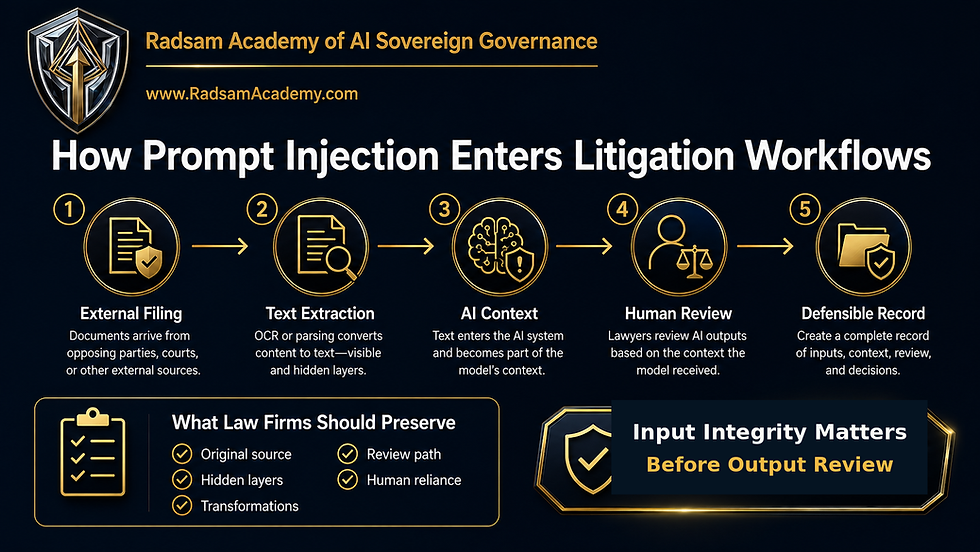
I would not begin with ‘Which model did we buy?’ I would ask: What entered the context? Was machine-readable content compared with what counsel could see? Was the original preserved before conversion or sanitization? Can material transformations and downstream outputs be reconstructed? Who made the human decision to rely? Those questions translate an AI-security concern into familiar litigation disciplines: preservation, provenance, discovery, privilege review, expert methodology, supervision and accountability.
A Litigation AI GRC Control Stack
Preserve, Inspect, Record, Restrict and Review
A proportionate control stack starts with the original source. Preserve it. Where the matter warrants it, inspect hidden text, comments, tracked changes, embedded objects, unusual layers and metadata. If a sanitized or analysis copy is created, record the transformation rather than silently replacing the original. Know the vendor boundary: which platform extracted the content, what was retained or transmitted, and whether the path can be reproduced. For higher-risk workflows, restrict permissions and require accountable human review before consequential reliance.
Action for Managing Partners: If your firm uses external litigation documents inside AI-assisted workflows, do not wait for a challenged filing to discover whether the intake path is reconstructable. Start by mapping the document-to-model path and naming the accountable owner. |
From Hallucination Control to Input Integrity
Output Verification Is No Longer Enough
Elliott exposes two different assurance questions. Output integrity asks whether counsel independently verified the AI result. Input integrity asks whether the firm knows what information and instructions the AI actually received. A lawyer can carefully verify the final answer while remaining unaware that hidden material entered the model context. Strong litigation AI governance therefore treats the path into the model as part of the evidence trail, not as an invisible technical step owned entirely by software or a vendor.
Building a Defensible Review Path
From Shadow Audit to Court-Focused Examination
For higher-consequence matters, independent assurance can test whether the workflow produces evidence that can later be explained. Before filing, an Air-Gapped Shadow AI Audit can examine a defined process: source handling, hidden-content exposure, transformations, permissions, vendor dependencies, provenance and human-review controls. If the process becomes contested, a Judicial Forensic AI Audit may examine relevant records and methodology within an appropriately defined expert, joint-retainer or court-appointed mandate. A Sovereign Sanctuary Vault can support controlled offline examination, but air-gapping itself does not guarantee privilege, admissibility, compliance or outcome.
I would welcome to exchange insights with AI and Legal Professionals in comments, and if you find this article helpful, I appreciate sharing with your network.
Author: Pouya Shafabakhsh Co-Founder, CAIO & Principal Forensic AI Auditor, Radsam Academy of AI Sovereign Governance. Independent AI governance and forensic-audit analysis. Educational information only; not legal advice.
FAQ: Prompt Injection Litigation AI
What is prompt injection in litigation?
It is the use of instructions embedded in material an AI system processes, potentially influencing how the system interprets or responds to that material.
Did Elliott ban lawyers from using generative AI?
No. The sanction addressed concealed machine-directed content and the filing process; it was not a general prohibition on verified AI-assisted legal work.
Did AI influence the Elliott ruling?
The court stated that the Connecticut Judicial Branch did not use AI to review the filing, so the decision did not find that AI changed the judicial outcome.
Does Elliott control New York or Ontario courts?
No. It is a Connecticut Superior Court order. Its broader value here is as an operational risk signal, not as binding New York or Ontario authority.
Which documents deserve the most attention?
Risk-based review is most useful for externally sourced or consequential materials such as opposing filings, productions, exhibits, expert materials and retrieved public content.
Is air-gapping enough to stop prompt injection?
No. Air-gapping can reduce selected external-connectivity pathways, but it does not by itself detect concealed instructions already present inside a document.
What should a Managing Partner do first?
Map where external documents enter AI-enabled litigation workflows, identify the highest-consequence use cases, and test whether the firm can reconstruct the path from source to human reliance.
Would you be opposed to finding your firm's AI gaps before opposing counsel or insurance companies do? I invite you to assess your firm using our AI Risks Calculator. Safely, securely, privately, and confidentially—with no need to enter any information, not even your email address—you can get a comprehensive AI Risks and Liabilities report in just five minutes.
If you have a sensitive file and want to protect it against AI hallucinations, bias, algorithmic discrimination, and AI-assisted risks through an Air-Gapped Shadow AI Audit before court, or if you are involved in a legal dispute related to AI and need a Judicial Forensic AI Audit, at Radsam, we are willing to assist you whether through our human-based services or by providing our in-house solution, the Sovereign Sanctuary Vault. In these cases, I invite you to fill out our Pre-Qualifying Assessment Form. We will review your information, qualifications, and capacity, and will contact you within two business days.
FAQ
What practical problem does prompt-injection litigation controls solve for legal teams?
prompt-injection litigation controls matters when it changes a legal, operational, or evidentiary decision. Start with the actual workflow and consequence. Then choose controls proportionate to the matter.
Which authorities should counsel verify before relying on prompt-injection litigation controls?
Start with binding law, court rules, professional duties, and contracts relevant to prompt-injection litigation controls. Separate guidance from mandatory authority. Recheck time-sensitive requirements before relying on them.
Which records best explain prompt-injection litigation controls if later challenged?
Preserve the sources, material outputs, versions, reviewers, approvals, and exceptions tied to prompt-injection litigation controls. Keep the record proportionate. It should explain consequential decisions without collecting everything.
Where should human review occur within prompt-injection litigation controls workflows today?
Human review should occur before prompt-injection litigation controls affects advice, evidence, filings, or external action. The reviewer needs authority to correct or stop the process. Record material overrides.
How should vendors support prompt-injection litigation controls without expanding unnecessary risk?
Technology supporting prompt-injection litigation controls should fit the defined workflow and data sensitivity. Review access, retention, security, exports, and vendor dependencies. Do not treat architecture as a legal guarantee.
When does independent review add value for prompt-injection litigation controls decisions?
Independent review helps when prompt-injection litigation controls raises unresolved technical or evidentiary questions. Define a narrow mandate first. Keep legal conclusions with counsel and technical findings within verified limits.
Which misconception most often distorts decisions about prompt-injection litigation controls today?
Do not assume one tool, log, metric, or control settles prompt-injection litigation controls. Context and corroborating evidence still matter. State technical findings proportionately and preserve important limitations.
Related Articles
For the governing or strategic frame behind prompt injection litigation: what law firms must prove, 22 NYCRR Part 161 verification explains filing verification, source control, and signer responsibility.
To compare the closest operational issue raised by prompt injection litigation: what law firms must prove, Part 161 verification in practice examines filing verification, source control, and signer responsibility.
For the evidence and reconstruction layer connected to prompt injection litigation: what law firms must prove, New York AI-Assisted Filings: Five Checks Before Signature focuses on filing verification, source control, and signer responsibility.
To connect prompt injection litigation: what law firms must prove with governance or implementation choices, New York AI Filing Reviews: When Independent Verification Adds Value covers filing verification, source control, and signer responsibility.
For the next practical decision after prompt injection litigation: what law firms must prove, cloud, local, and air-gapped deployment choices provides context on confidentiality, vendor access, data location, and architecture boundaries.


Comments