
Ontario AI Class Actions: Map Decisions Across Versions and Cohorts

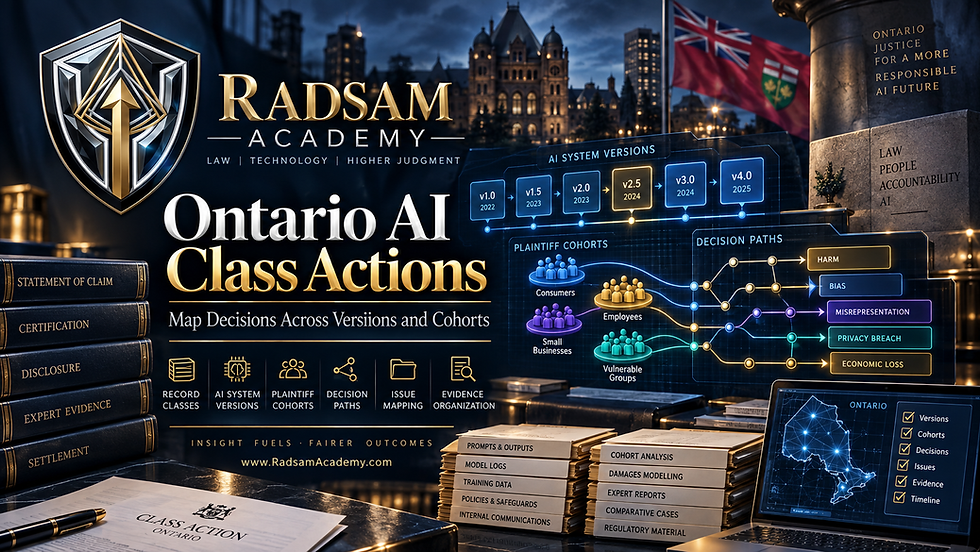
An Ontario class-action litigation lead needs to know whether the system described today matches the process affecting the relevant groups during the disputed period. A threshold change or human override can make one general description incomplete. Build a register that keeps time period, configuration, cohort and human action separate, with a source for each connection. The result is a bounded factual map: what is supported, what varies and what remains unknown. It helps counsel frame targeted technical questions without assuming that every change explains an alleged harm. In a fictional decision system, a threshold changes halfway through the review period while one team continues to use the previous human override process. A single system label hides both differences. The working register should therefore distinguish the configuration from how people used it, and identify the source supporting each date range. That gives the litigation team a concrete way to narrow a records question instead of treating the entire period as technically uniform.
Why AI Class Actions Create Evidence-Scale Problems
A conventional decision may have one policy and one set of records. An AI-enabled process can change with data, configuration, model updates, prompts, thresholds or vendor releases. A class definition may span months or years, which means the system in place at the end of the period may not be the system that produced earlier outcomes. A single screenshot of the current interface does not answer that problem. The second issue is organizational fragmentation. Legal may describe the system as advisory; operations may have treated its output as decisive. A vendor may call a field a recommendation score while managers use it as a practical cutoff. Communications teams may summarize a process differently from technical staff. Those discrepancies do not automatically prove liability, but they become important when plaintiffs seek common evidence about how decisions were made.
The Records That Become Hard to Reconstruct
Start with version history and decision criteria. Identify major model or rule changes, material thresholds, human override paths and exception handling. Preserve governance documents that were actually operative during the relevant period, not only the policy adopted after litigation began. Identify complaint records, incident reviews and validation work that may explain known limitations. If a third-party vendor controlled key logs, confirm what remains available and what can be exported under the contract. Discovery obligations remain governed by the applicable procedural rules, relevance, proportionality, privilege and court orders. In Ontario, parties should resist both overcollection and under-preservation. If expert evidence later relies on quotations from authorities, documents or records, the current Rule 53.03 quotation-accuracy certification reinforces the importance of a clean source record. The rule does not create a general obligation to preserve every AI interaction.
How to Separate Allegation From Technical Fact
Class-action pleadings often use broad descriptions because discovery has not yet occurred. Defense counsel should avoid answering broad allegations with equally broad marketing language. Build a neutral technical chronology: what system existed, who owned it, what inputs were available, what output it produced, what humans did, what changed and what records support each point. Mark unresolved questions as unresolved instead of filling gaps with assumptions. This is where independent technical review can add value. A Judicial Forensic AI Audit can examine a defined system or evidentiary record during a dispute and explain technical facts without deciding legal liability. If the concern is earlier—before a key affidavit, expert report or factum is filed—a Shadow AI Audit can test the review and evidence chain. A Sovereign Sanctuary Vault can support isolated handling of selected materials while reducing external connectivity and public-cloud exposure pathways.
A Matter-Level Readiness Plan
For the litigation lead, assign one technical owner to the register and one counsel contact for the relevance and preservation decisions. Agree the period, potentially relevant groups, available sources and limits before reconstruction begins. If similar technical questions recur across matters, reserve review time against forecast milestones and revisit the recurring gaps quarterly. A scoped technical review can explain the record; complex class-wide reconstruction, expert testimony and additional hearing work require an accepted mandate and sufficient capacity rather than an assumed blanket retainer.
A useful class-action discipline is to separate the legal hold from the technical map. The legal hold answers what potentially relevant information must be preserved under counsel's direction. The technical map answers where AI-related records may actually exist: internal systems, vendor portals, exported reports, model-version notes, complaint systems and human-override records. Keeping those two questions distinct helps avoid the common extremes of preserving everything indefinitely or discovering too late that a key vendor record expired. It also gives experts a cleaner starting point if the dispute later turns on commonality, causation, system behavior or the reliability of a representative sample.
Author: Pouya Shafabakhsh Co-Founder, CAIO & Principal Forensic AI Auditor, Radsam Academy of AI Sovereign Governance. Independent AI governance and forensic-audit analysis. Educational information only; not legal advice.
Would you be opposed to finding your firm's AI gaps before opposing counsel or insurance companies do? I invite you to assess your firm using our AI Risks Calculator. Safely, securely, privately, and confidentially—with no need to enter any information, not even your email address—you can get a comprehensive AI Risks and Liabilities report in just five minutes.
If you have a sensitive file and want to protect it against AI hallucinations, bias, algorithmic discrimination, and AI-assisted risks through an Air-Gapped Shadow AI Audit before court, or if you are involved in a legal dispute related to AI and need a Judicial Forensic AI Audit, at Radsam, we are willing to assist you whether through our human-based services or by providing our in-house solution, the Sovereign Sanctuary Vault. In these cases, I invite you to fill out our Pre-Qualifying Assessment Form. We will review your information, qualifications, and capacity, and will contact you within two business days.
FAQ
What practical problem does Ontario AI class actions solve for legal teams?
Ontario AI class actions matters when it changes a legal, operational, or evidentiary decision. Start with the actual workflow and consequence. Then choose controls proportionate to the matter.
Which authorities should counsel verify before relying on Ontario AI class actions?
Start with binding law, court rules, professional duties, and contracts relevant to Ontario AI class actions. Separate guidance from mandatory authority. Recheck time-sensitive requirements before relying on them.
Which records best explain Ontario AI class actions if later challenged?
Preserve the sources, material outputs, versions, reviewers, approvals, and exceptions tied to Ontario AI class actions. Keep the record proportionate. It should explain consequential decisions without collecting everything.
Where should human review occur within Ontario AI class actions workflows today?
Human review should occur before Ontario AI class actions affects advice, evidence, filings, or external action. The reviewer needs authority to correct or stop the process. Record material overrides.
How should vendors support Ontario AI class actions without expanding unnecessary risk?
Technology supporting Ontario AI class actions should fit the defined workflow and data sensitivity. Review access, retention, security, exports, and vendor dependencies. Do not treat architecture as a legal guarantee.
When does independent review add value for Ontario AI class actions decisions?
Independent review helps when Ontario AI class actions raises unresolved technical or evidentiary questions. Define a narrow mandate first. Keep legal conclusions with counsel and technical findings within verified limits.
Which misconception most often distorts decisions about Ontario AI class actions today?
Do not assume one tool, log, metric, or control settles Ontario AI class actions. Context and corroborating evidence still matter. State technical findings proportionately and preserve important limitations.
A practical worksheet
Illustrative exercise. A fictional decision system changed its threshold midway through a period under review. The worksheet separates system changes from questions counsel must decide about the claims. Period. Identify the relevant date range, known configurations and evidence supporting when each change became operational. Variation. Record which populations or transactions encountered each configuration, noting incomplete coverage rather than assuming uniform treatment. Override. Identify relevant human review or override records and distinguish an automated recommendation from the action ultimately taken. Decision. Use the register to identify the factual variation that needs further investigation; it does not establish causation or class-wide liability. Record note. Keep the population field distinct from the configuration field, because the same system description may conceal different human processes across affected groups. The review measure should match the reconstruction question. For example, record how many relevant period-and-cohort combinations have an identified configuration source and human-process record, out of the combinations selected for review. Separate “not applicable,” “not available” and “not yet checked”; those labels mean different things. A high coverage figure still does not prove causation or resolve legal commonality. The useful result is a transparent boundary around what the technical record supports, allowing counsel to prioritize the next retrieval or expert question without mistaking gaps for uniform treatment.
Next step
Test the register on a fictional threshold change affecting two groups with different human-review processes. Mark every unsupported period or cohort connection as unknown. Use the resulting coverage map to identify one targeted records question, without discussing real class members or matter facts publicly.
Preferred Source on Google
Want Radsam Academy's future analysis to be easier to find in Google Search, AI Mode, and AI Overviews? Add Radsam Academy as a Preferred Source on Google.
Related Articles
For the governing or strategic frame behind ontario ai class actions: map decisions across versions and cohorts, AI-assisted eDiscovery controls explains record ownership, preservation, proportionality, and discovery scope.
To compare the closest operational issue raised by ontario ai class actions: map decisions across versions and cohorts, New York AI Discovery: Separate User Records from Vendor Records examines record ownership, preservation, proportionality, and discovery scope.
For the evidence and reconstruction layer connected to ontario ai class actions: map decisions across versions and cohorts, Ontario AI Discovery Plans: Tie Each Record Class to an Issue focuses on record ownership, preservation, proportionality, and discovery scope.
To connect ontario ai class actions: map decisions across versions and cohorts with governance or implementation choices, Ontario AI Legal Holds: Build a Usable Record-and-Owner Map covers record ownership, preservation, proportionality, and discovery scope.
For the next practical decision after Ontario AI class actions: map decisions across versions and cohorts, an operational AI GRC framework provides context on governance architecture, ownership, and implementation sequencing.


Comments