
Ontario AI Legal Holds: Build a Usable Record-and-Owner Map

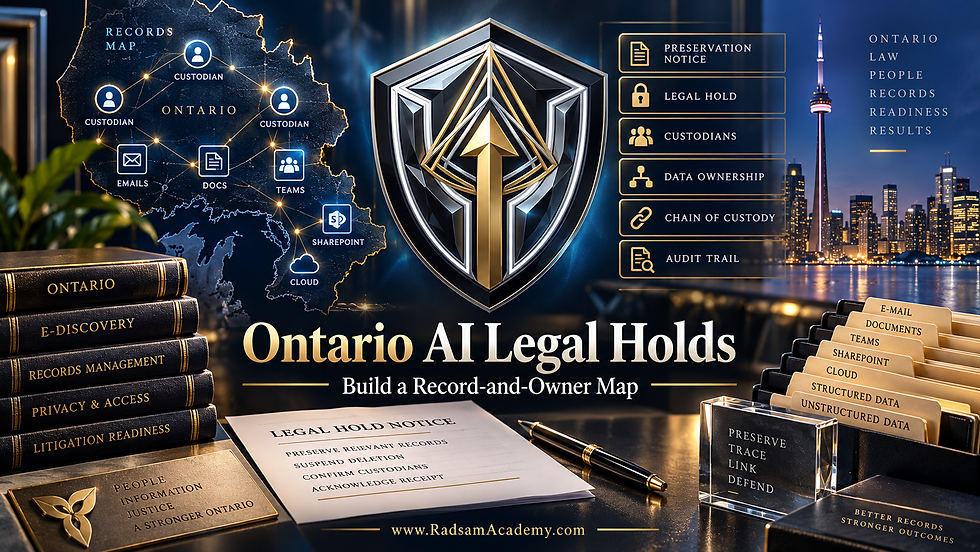
For an Ontario litigation partner, a useful AI legal hold is one a custodian can act on. Naming the tool is only the start: the instruction needs an identifiable record class, an owner and a preservation step that actually works. A record-and-owner map turns that need into a practical handoff. Its result is modest but valuable: counsel can distinguish confirmed actions from unresolved vendor dependencies before treating the instruction as operational. The same map can support several matters without assuming that their legal preservation scope is identical. For Ontario teams, that question sits inside familiar discovery principles rather than a new universal AI-preservation statute. Rules 29.1 and 29.2 require discovery planning and proportionality, while Rule 30 governs documentary discovery. The governance task is to translate those existing duties into an AI-aware preservation map.
1. Start With the Matter, Not the Tool
Map the consequential uses
Begin with the legal and business decisions that may matter in the proceeding. Was AI used to summarize evidence, classify documents, draft a factum, compare contracts, identify prior art, prepare an expert, or recommend a production decision? Those uses create different preservation needs. A generic instruction to preserve 'all AI data' is usually too broad to manage and too vague to guide custodians. Identify who controlled the workflow Record the people, systems and repositories involved. The relevant custodian may be a lawyer, client employee, eDiscovery vendor, consultant, expert or shared litigation-support team.
2. Separate Source Evidence From AI Interaction Records
Native source documents remain the foundation. If an AI system summarized, ranked or compared a collection, preserve the underlying records and the collection boundaries that defined what the system could see. A prompt cannot repair a missing source population.
Preserve material interactions proportionately
Not every prompt is equally important. A useful triage rule is to retain interactions that materially influenced factual positions, production decisions, expert instructions, settlement analysis, court submissions or other significant legal work, subject to counsel's privilege and preservation analysis. Routine drafting experiments that had no effect on the matter may present a different case. Document the distinction instead of assuming one rule fits every interaction.
3. Use Ontario Discovery Rules as the Frame
Build AI records into the discovery plan
Rule 29.1 makes the discovery plan a natural place to think about sources of electronically stored information, timing, scope and method. Rule 29.2 adds proportionality. Neither rule names generative AI as a special category, but both support a disciplined conversation about whether prompts, outputs, logs, model identifiers or vendor records are relevant and reasonably retrievable. The legal decision remains counsel's; the technical map should make that decision informed rather than speculative.
4. Define the Technical Preservation Envelope
Capture model and configuration context
Where reproducibility could matter, record the model or system used, material version information, retrieval configuration, date and time, relevant access role, and any workflow setting that could change the result. The point is not to freeze an entire vendor platform.
Test export and retention before relying on them
Test the proposed action using a permitted sample or synthetic record. Record whether the export includes the expected date range, attachments and available metadata, and where the retained copy will sit. If the owner cannot complete the step, create an exception with a named person and review date. A product history screen alone does not establish that this process works.
5. Protect Confidentiality While Preserving Defensibility
Minimize unnecessary replication Preservation should not become uncontrolled copying. Keep sensitive matter data within approved repositories, preserve metadata when useful, restrict access by role, and record any collection or export that crosses a vendor or jurisdictional boundary. An air-gapped environment can reduce selected external connectivity pathways for examination, but it does not itself determine privilege, discoverability or legal sufficiency. Those questions remain fact-specific.
6. Give the Managing Partner a Decision Record
Record scope, rationale and exceptions
A short hold addendum can identify the AI workflows in scope, the records to preserve, the responsible owner, the retention method, known vendor limitations, privileged or protected categories, and any conscious exclusion. This is more useful than a policy slogan because it shows how the firm applied judgment to the actual matter. Review the map when the pleadings, custodians, expert issues or technology materially change.
Author: Pouya Shafabakhsh Co-Founder, CAIO & Principal Forensic AI Auditor, Radsam Academy of AI Sovereign Governance. Independent AI governance and forensic-audit analysis. Educational information only; not legal advice.
Would you be opposed to finding your firm's AI gaps before opposing counsel or insurance companies do? I invite you to assess your firm using our AI Risks Calculator. Safely, securely, privately, and confidentially—with no need to enter any information, not even your email address—you can get a comprehensive AI Risks and Liabilities report in just five minutes.
If you have a sensitive file and want to protect it against AI hallucinations, bias, algorithmic discrimination, and AI-assisted risks through an Air-Gapped Shadow AI Audit before court, or if you are involved in a legal dispute related to AI and need a Judicial Forensic AI Audit, at Radsam, we are willing to assist you whether through our human-based services or by providing our in-house solution, the Sovereign Sanctuary Vault. In these cases, I invite you to fill out our Pre-Qualifying Assessment Form. We will review your information, qualifications, and capacity, and will contact you within two business days.
FAQ
What practical problem does Ontario AI preservation solve for legal teams?
Ontario AI preservation matters when it changes a legal, operational, or evidentiary decision. Start with the actual workflow and consequence. Then choose controls proportionate to the matter.
Which authorities should counsel verify before relying on Ontario AI preservation?
Start with binding law, court rules, professional duties, and contracts relevant to Ontario AI preservation. Separate guidance from mandatory authority. Recheck time-sensitive requirements before relying on them.
Which records best explain Ontario AI preservation if later challenged?
Preserve the sources, material outputs, versions, reviewers, approvals, and exceptions tied to Ontario AI preservation. Keep the record proportionate. It should explain consequential decisions without collecting everything.
Where should human review occur within Ontario AI preservation workflows today?
Human review should occur before Ontario AI preservation affects advice, evidence, filings, or external action. The reviewer needs authority to correct or stop the process. Record material overrides.
How should vendors support Ontario AI preservation without expanding unnecessary risk?
Technology supporting Ontario AI preservation should fit the defined workflow and data sensitivity. Review access, retention, security, exports, and vendor dependencies. Do not treat architecture as a legal guarantee.
When does independent review add value for Ontario AI preservation decisions?
Independent review helps when Ontario AI preservation raises unresolved technical or evidentiary questions. Define a narrow mandate first. Keep legal conclusions with counsel and technical findings within verified limits.
Which misconception most often distorts decisions about Ontario AI preservation today?
Do not assume one tool, log, metric, or control settles Ontario AI preservation. Context and corroborating evidence still matter. State technical findings proportionately and preserve important limitations.
A practical worksheet
Illustrative exercise. A fictional Ontario matter involves an AI-assisted document summary. The worksheet supports counsel’s preservation analysis; it does not decide which records must legally be retained. Workflow. Identify the consequential use and potentially relevant source documents, saved interaction records and available technical logs. Owner. Record who controls each category, whether a vendor is involved and what retention or export limits are known. Scope. Provide date ranges, relevance questions and practical retrieval constraints for counsel to determine the hold instruction and any exclusions. Decision. Test whether a custodian can follow the resulting instruction and identify an owner for unresolved vendor questions before relying on the map. Record note. Confirm that the identified owner can perform the proposed preservation step; an inventory entry alone does not demonstrate that retention is operational. For a recurring workflow, the litigation-support owner can maintain a shared template while keeping each matter’s instructions separate. A simple dashboard counts counsel-scoped record classes with a confirmed executable action against all scoped classes, alongside the age of unresolved exceptions. For example, a fictional map covering four classes may show three confirmed actions and one provider dependency; that fourth class remains visibly unresolved rather than disappearing inside an overall completion label. Review recurring export failures when selecting the next process improvement. These are operational measures, not proof that preservation duties have been satisfied.
Preferred Source on Google
Want Radsam Academy's future analysis to be easier to find in Google Search, AI Mode, and AI Overviews? Add Radsam Academy as a Preferred Source on Google.
Related Articles
For the governing or strategic frame behind ontario ai legal holds: build a usable record-and-owner map, AI-assisted eDiscovery controls explains record ownership, preservation, proportionality, and discovery scope.
To compare the closest operational issue raised by ontario ai legal holds: build a usable record-and-owner map, New York AI Discovery: Separate User Records from Vendor Records examines record ownership, preservation, proportionality, and discovery scope.
For the evidence and reconstruction layer connected to ontario ai legal holds: build a usable record-and-owner map, Ontario AI Discovery Plans: Tie Each Record Class to an Issue focuses on record ownership, preservation, proportionality, and discovery scope.
To connect ontario ai legal holds: build a usable record-and-owner map with governance or implementation choices, New York AI Class Actions: Preserve the System State That Matters covers historical system state, cohort variation, and class-wide evidence.
For the next practical decision after ontario ai legal holds: build a usable record-and-owner map, AI agent authority and approvals provides context on agent authority, permissions, human approval, and traceability.


Comments